Healthy Calf Conference
Follow to stay up-to-date on all Healthy Calf Conference updates. Speaker announcements, sponsorship information, registration announcements, and more.
By Dr. Michael Steele, University of Guelph
From nutrition to health management, calf research is advancing quickly, and some of the most impactful research is happening right here in Ontario.
At the University of Guelph, our research teams in the Department of Animal Biosciences and the Department of Population Medicine, at the Ontario Veterinary College, are committed to advancing calf success through innovative research. From collaborating with producers to collecting samples and asking the tough questions, our goal is to identify strategies that support calf health and productivity.
Together, we address some of the most pressing challenges in dairy, veal, and dairy-beef production. Our current calf research program focuses on:
So, what have we learned?
One clear takeaway from our research is that early life management is one of the most influential factors shaping calf success. Our research begins at the cow-level, where we aim to better understand how colostrum is formed and strategies to improve both its quality and quantity. We also continue to explore the critical role of colostrum for the calf, with recent work expanding our understanding of transition milk, milk feeding, gut development, and immune function. Together, these findings highlight how nutrition in the first days and weeks of life can shape health and performance outcomes later in life.
However, our research has shown that calf success doesn’t come from one thing alone. Colostrum, nutrition, hygiene, housing, transportation, and disease detection all matter. The most effective calf programs are the ones that manage the calf and the system, together. The insights from our research can give producers the tools to make better, more informed decisions on-farm, that support calf health, growth, and long-term success.
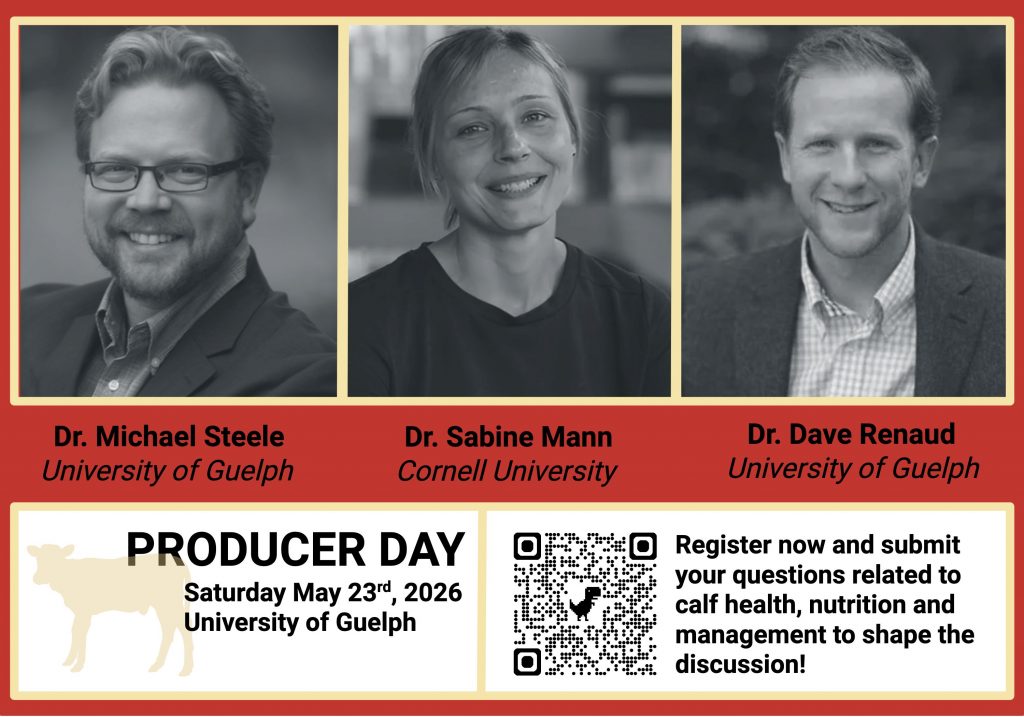
That is exactly why we want to invite producers to campus on May 23, 2026, to take part in our Producer Day at the II International Scientific Meeting on Colostrum at the University of Guelph.
We want this event to be driven by you. When you register, you will have the chance to submit questions you want answered about calves, colostrum, health, nutrition, management, and performance. Those questions will shape the morning program. Our keynote speakers will respond directly to the topics that matter most to the people actually raising and managing calves.
The morning session will feature Drs. David Renaud and Michael Steele from the University of Guelph and Dr. Sabine Mann from Cornell University. We will be answering questions submitted by registered attendees and focusing on practical, science-based information that producers can use on-farm. We will also have a producer panel, selected student presentations, and an optional tour of our research stations. And yes, to make the trip worthwhile, beef on a bun will be served.
We also want to celebrate the accomplishments of researchers and students at the University of Guelph, as we’re incredibly proud of what our students, staff, and collaborators have accomplished in calf research. Our students have earned major awards at scientific conferences, including the American Dairy Science Association (ADSA) annual meeting, presented their work at international meetings, and published high-impact papers at a remarkable pace. In fact, in both 2024 and 2025, the University of Guelph led all institutions in calf-related presentations at ADSA, highlighting our significant contribution to the field. Additionally, two of our calf researchers were recently entered into the Journal of Dairy Science “100 Club”, each publishing more than 100 papers in their careers in this journal.
We think the best way to share that work is not just to publish it, but to open the doors and invite producers in. We are serious about making this one of the biggest calf-focused producer events that the University of Guelph has ever hosted. We want the room full. We want good discussion. We want tough questions. We want producers, calf growers, veterinarians, nutritionists, students, and industry partners all learning from each other.
We hope you will join us on May 23. Register here.
Follow to stay up-to-date on all Healthy Calf Conference updates. Speaker announcements, sponsorship information, registration announcements, and more.
The Codes of Practice are nationally developed guidelines for the care and handling of farm animals. They serve as our national understanding of animal care requirements and recommended practices.