Healthy Calf Conference
Follow to stay up-to-date on all Healthy Calf Conference updates. Speaker announcements, sponsorship information, registration announcements, and more.
Harold K. House, M.Sc., P. Eng., DairyLogix
The barn or room design of a calf nursery has a major influence on calf health along with nutrition, health protocols, and of course management. There are two factors of the barn design, the room environment – what the calf feels, and the calf environment – what the calf touches. The room environment consists of temperature and ventilation, and the calf’s environment consists of space allowance, bedding, and drainage. The ventilation component can be broken down further to consist of air quality, air quantity, air speed, and air direction.
When asked what the best housing for a newborn calf is, I always answer a well-managed calf hutch. But the answer is not always the same when the calf manager is asked. If a manager is not prepared to feed and treat the calf in all weather conditions, then providing indoor housing for the calf to improve all aspects of calf management becomes the better choice.
Temperature becomes the next consideration. A newborn calf has a thermal neutral zone, between 10oC to 26oC (50oF to 78.8oF). After a month this range changes to 0oC to 23oC (32oF to 73.4oF). The thermal neutral zone is the temperature at which the calf can thrive. These conditions can be achieved by adjusting the air temperature with added heat or by providing calf coats to insulate the calf from colder temperatures.
The most important barn design influence on the calf’s health is ventilation. The first aspect of ventilation is air quality or simply put, fresh air. By fresh air we mean air that has a low coliform or bacteria count. The next is air quantity. In the winter the purpose of ventilation is to remove excess moisture and gases. The minimum recommended amount is four air changes of the barn or room per hour. In the summer, it is to remove excess heat and 40 to 60 air changes per hour are recommended. The air changes for spring and the fall should be 20 to 40. Air speed at calf level is also very important. In the cold of winter, the air speed at calf level should be less than 0.3 metres per second (m/s) (60 feet per minute (fpm)). The air should be distributed evenly throughout the room so in the winter the calf does not feel it as a draft. While in the summer the air speed can be 0.8 to 1.3 m/s (150 to 250 fpm) and blown directly on the calf so that it has a cooling effect.
The challenge then becomes having a year-round ventilation system that is appropriate for the small amount of fresh air for the winter, increased ventilation for the shoulder seasons of spring and fall, and finally the large amounts of fresh air that is required for summer ventilation.
Ventilation systems are usually divided into two types, natural ventilation and mechanical or fan ventilation, with most natural ventilation systems still using some form of fans as well.
The best method to supply the small amount of fresh air that is required in the winter is with a positive pressure ventilation tube (PPVT) system. A PPVT system consists of a fan drawing fresh air directly in from the outside and blowing it into a tube with holes to distribute the air uniformly throughout the room. The hole size spacing and position on the tube are calculated to distribute the air uniformly and at a speed that will be reduced to 0.3 m/s (60 fpm) at calf level. Researchers at the University of Wisconsin have developed a spreadsheet for designing PPVT systems.
The calf environment, what the calf touches, also greatly influences the health of the calf. This includes the space allowance for each calf. Research has shown that the airborne pathogen count drops significantly from a floor space of 3 m2 (32 ft2) per calf to 3.2 m2 (40 ft2) per calf. The Code of Practice for the Care and Handling of Veal Cattle recommends a minimum air space of 10 m3 per 100 kg (353 ft3 per 220 lb). If we consider a typical room height of 0.3 m (10 ft), at 3 m2 (32 ft2) per calf the room volume per calf would be 9 m3 (320 ft3) or slightly less than the recommended amount. While providing 3.2 m2 (40 ft2) of floor area, the room volume would be 11.3 m3 (400 ft3) which would exceed the recommendations. It is important to note that this is the bedded floor space per calf. This means it is the size of an individual pen or in a group pen it is the size of the bedded area and not the total pen size.
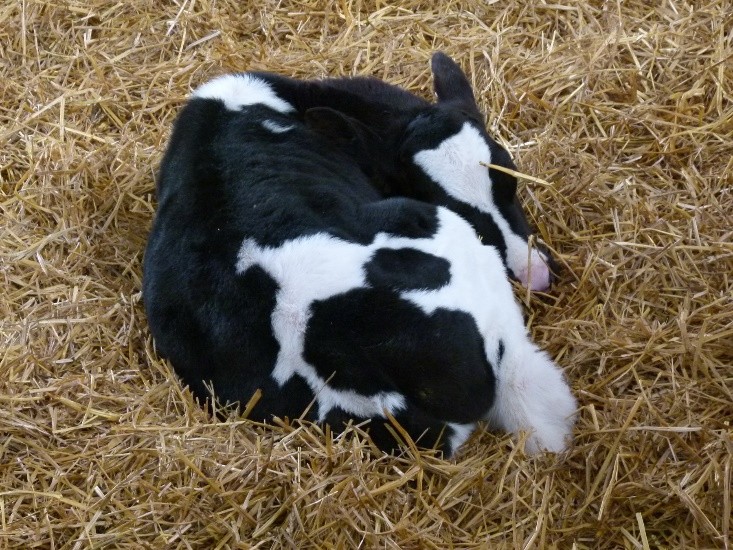
Clean dry bedding is the next physical factor that is important and that starts with drainage. There are many options to provide good drainage. Choose one that will remove seepage from urine and spilled milk and water. This goes hand in hand with the type and amount of bedding. In hot weather, use shavings to reduce flies but in cold weather long straw is needed to provide insulation in both hutches and individual pens. The Dairyland Initiative provides guidelines for the amount of bedding that should be used, but it basically comes down to enough bedding to allow the calf to nestle down into it to the point that it will cover their legs.
The other physical factor to note is a cross over between ventilation, pen design, and bedding, and that is protection from drafts. Solid panels can be used strategically in individual pens or group pens to protect the calf from drafts. Use lots of long straw bedding in the winter, it not only insulates the calf but also protects the calf from drafts.
Socialization is a final consideration with the barn and pen design. Numerous studies have shown the advantage of socialization by rearing calves in groups or with a “buddy”. This can be easily accomplished with individual pens by removing a divider between pens when appropriate. However, management strategies to avoid cross-suckling need to be followed.
Barn or room design has a major influence on calf health. The room environment – what the calf feels, and the calf environment – what the calf touches, are key components. The proper design with good nutrition and following health protocols provide the keys. Following these keys with careful management will produce healthy calves for the future herd.
Follow to stay up-to-date on all Healthy Calf Conference updates. Speaker announcements, sponsorship information, registration announcements, and more.
The Codes of Practice are nationally developed guidelines for the care and handling of farm animals. They serve as our national understanding of animal care requirements and recommended practices.